Repair oddities from the bench
Every so often an Omnichord arrives with a fault that refuses to behave like a normal fault. Area 51 is where those stranger discoveries live: unusual symptoms, red herrings, quiet little factory revisions and repair notes that may help the next person who meets the same gremlin.
These notes are shared as workshop observations rather than formal service bulletins. They are intended for confident repairers working carefully with vintage instruments.
Workshop note 001
Early OM-27 IC 4001 floating-input stability modification
Occasionally we have an Omnichord come in for repair that proves to be a head-scratcher. This early OM-27 had one of those faults.
Randomly, chords would sound slightly distorted and notes would drop out. The second problem was tricky to find, but turned out to be a poor solder connection around the AY-5 1317A. The chord distortion was the really frustrating fault.
On the bench it behaved perfectly and checked out with a scope, but moving or flexing the PCB caused the problem to occur. Putting it down resulted in the problem disappearing.
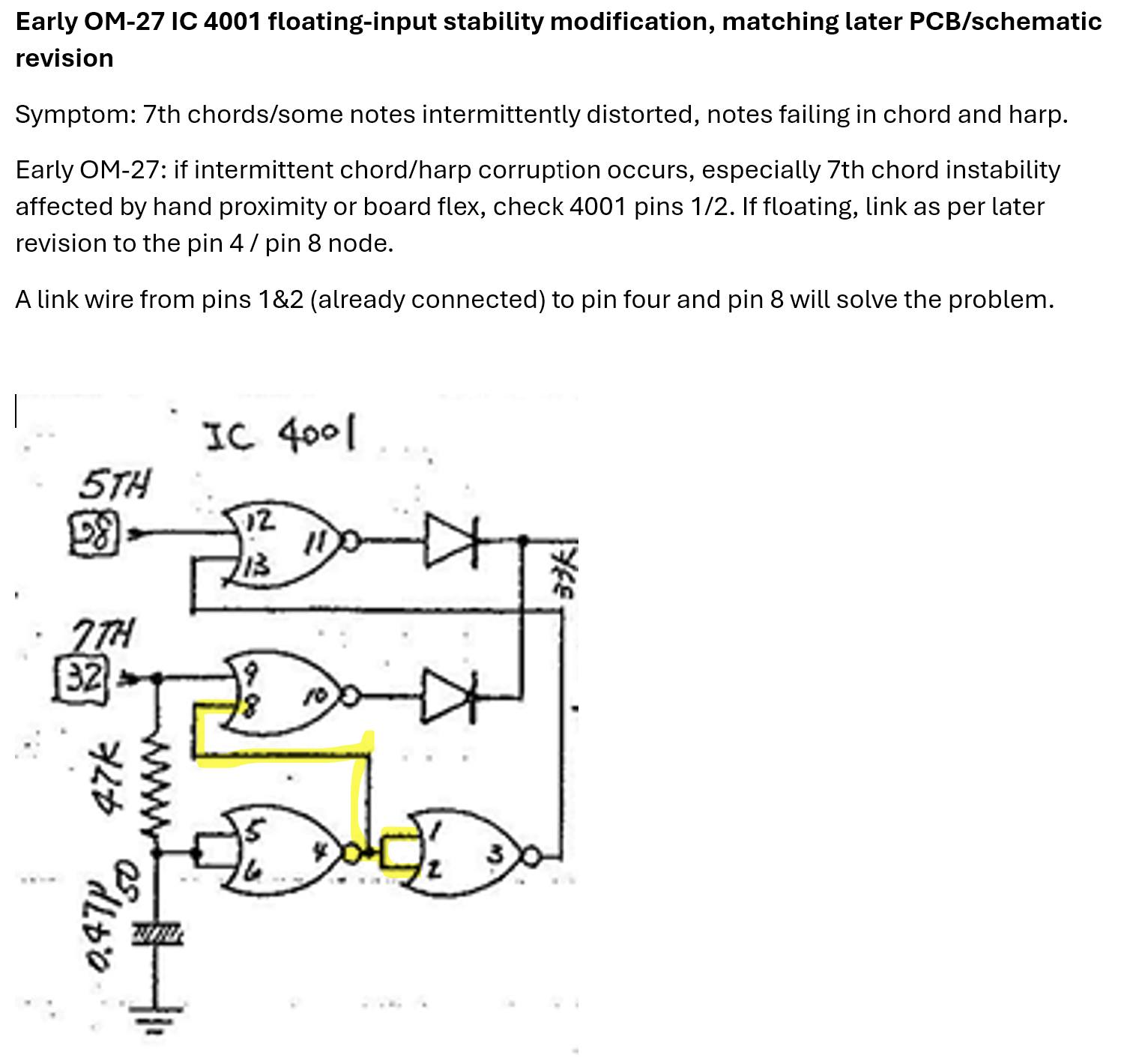
I reflowed around many of the components to no avail. Then, going over the board with a scope again, out of desperation, I found that touching pin 1 of the 4001 IC triggered the fault. Touching it again cleared the fault. I then realised I did not even need to touch the board to trigger it. The movement and flexing had been a red herring: the fault appeared because my hand was near the IC while holding the board.
On looking at the schematics I could see pins 1 and 2 were tied by PCB track to pins 4 and 8. Back in the 80s Suzuki must have come across the same issue and fixed it in later versions.
The fix
If intermittent chord or harp corruption occurs, especially 7th chord instability affected by hand proximity or board flex, check IC 4001 pins 1 and 2. If they are floating, link them as per the later revision to the pin 4 / pin 8 node.
Workshop note 002
OM-27 pitch range fault and early factory resistor variation
An early Suzuki OM-27 came in unable to tune up to concert pitch. The whole instrument was globally low, rather than one note or chord being wrong.
For example, a note that should have been C could only be adjusted roughly between F# and A, even with the pitch control at its limit. Because all notes were shifted together, the fault did not appear to be in the individual chord or note generation, keying, or divider section. The problem had to be somewhere in the master oscillator / tuning circuit before the notes were divided down.
The OM-27 schematic confirms that the pitch control affects the oscillator section feeding the divider circuitry, so a fault here would shift the entire instrument together.
Initial checks
A few measurements initially looked suspicious, but turned out to be normal:
- Around 5 V was present on the divider / logic IC supply.
- Around 2.3 V was seen in the pitch-control / tuning area.
- The pitch control itself measured correctly.
- Removing a nearby capacitor from circuit did not restore the missing pitch range.
A known-good OM-27 was then checked for comparison. It showed the same approximate readings, so those voltages were not the cause of the fault. They were normal circuit conditions, or at least not diagnostic on their own.
The discovery
A resistor in the tuning circuit was found to be 3.8 kΩ. This seemed odd, because another working OM-27 had a 1.5 kΩ resistor in the equivalent position. A spare board was also checked and had the same 3.8 kΩ value as the faulty unit.
The faulty unit was approximately serial number 7000, placing it within the first couple of months of OM-27 production. The working OM-27 with the 1.5 kΩ resistor was in the 15,000 serial-number range, around five months into production.
When the 3.8 kΩ resistor was replaced with 1.5 kΩ, the full pitch adjustment range was restored and the instrument could again be tuned to concert pitch.
Likely explanation
This does not appear to have been a random fault or bad repair. It looks like a factory variation or early production decision.
The OM-27 was designed primarily as an easy-play sing-along instrument, not as a precision synthesizer. It is therefore quite possible that the early resistor value was chosen to restrict the user pitch range, keeping the instrument in a pitch area considered comfortable for casual singing.
However, restricting the pitch range reduces the amount of adjustment available later in life. After decades of component ageing, an OM-27 with this restricted range may no longer be able to reach concert pitch. Later OM-27 / Omnichord designs appear to have handled this more elegantly by restricting the user pitch control while providing wider internal adjustment for factory or service calibration.
Practical repair note
If an OM-27 is globally too low or too high in pitch and cannot be brought to concert pitch with the external pitch control, first confirm the problem affects the whole instrument equally. Check the power rails and oscillator / tuning area, but do not assume that 5 V on the divider ICs or roughly 2.3 V in the tuning area is faulty without comparison.
Inspect the resistor value in the tuning circuit. If a 3.8 kΩ resistor is fitted where later boards use 1.5 kΩ, changing it to 1.5 kΩ may restore the full pitch-adjustment range.
This should not be treated as a universal modification. It is a useful repair path only where the symptoms match and the circuit position has been positively identified.
In this case, the OM-27 was not suffering from a failed divider IC, bad pitch potentiometer, or obvious supply problem. The real issue was that an early factory resistor value in the tuning circuit restricted the available pitch range so much that the instrument could no longer be adjusted to concert pitch.
Replacing the 3.8 kΩ resistor with 1.5 kΩ restored normal tuning range. One of those cases where the instrument was not exactly faulty in the usual sense; it was limited by an early production choice that no longer gives enough adjustment margin after more than forty years.
Workshop note 003
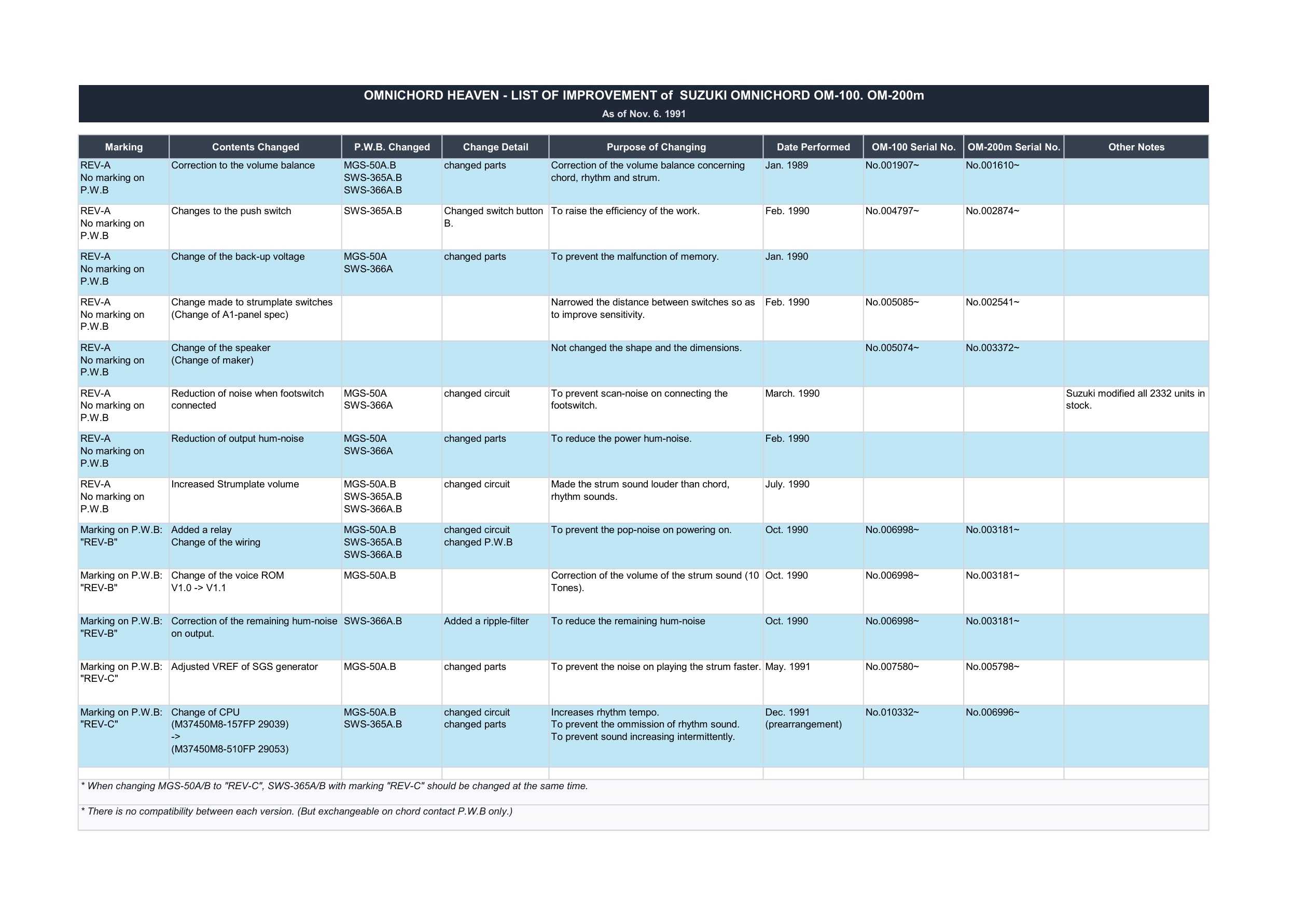
OM-100 / OM-200M factory improvement list
For around 35 years, the production changes between the OM-100 and OM-200M families have been one of those awkward Omnichord mysteries: visible on the bench, but difficult to tie to exact board revisions and serial-number ranges.
This newly prepared reference document brings those clues together. It reveals the known factory improvement trail up to November 6th 1991, including P.W.B. revision markings, contents changed, change details, dates performed and the related OM-100 / OM-200M serial-number thresholds.
The list includes practical service details such as volume-balance changes, push-switch improvements, backup-voltage revisions, strumplate-switch sensitivity changes, speaker changes, footswitch noise reduction, hum-noise improvements, the REV-B relay / pop-noise change, voice ROM V1.0 to V1.1, ripple-filter additions, VREF adjustment and the later CPU change associated with rhythm tempo and intermittent sound behaviour.
Download the reference sheet
The PDF version is best for reading the full table, keeping with a repair job, or sharing with another technician who is trying to identify a board revision.