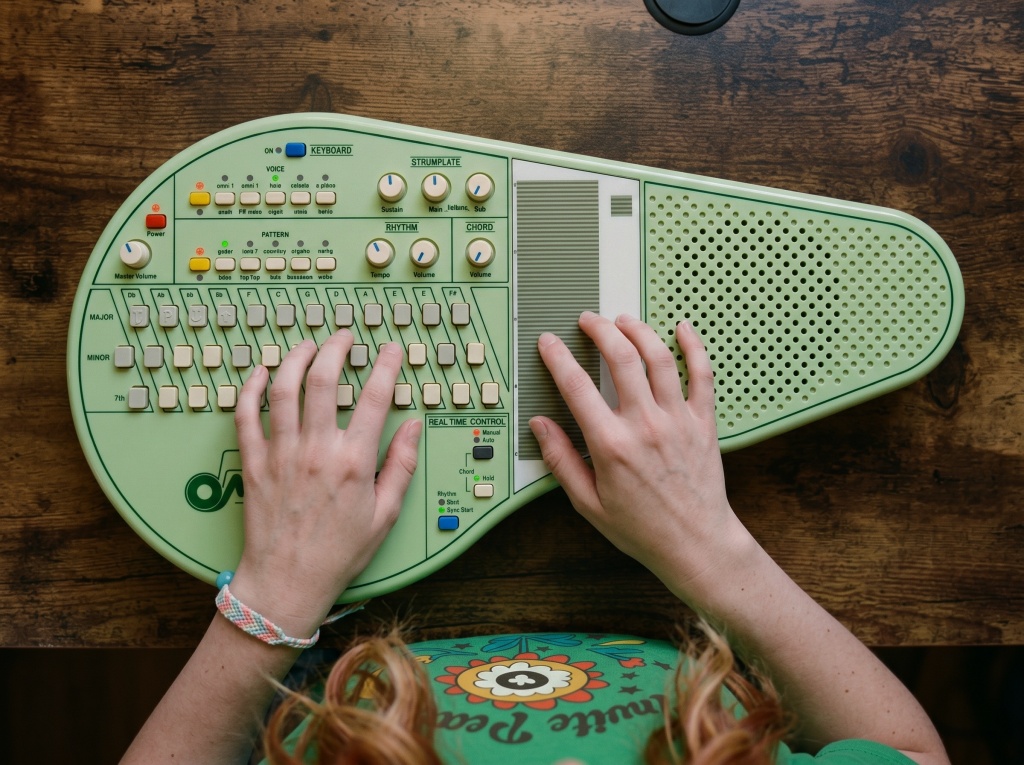
Begin here OM-108 lesson 1:53
Your first chord and strum.
Aisling introduces the main controls, helps you set the volumes, then guides you through a friendly C-major chord and your first gentle sweep across the strumplate. The controls vary between models, but the chord-and-strum idea is the same.
Now showing: Suzuki OM-108. Aisling guides you through setup, C major and your first strum.
Read the lesson transcript
Aisling: Right, let’s get you properly introduced to your Omnichord.
First, get yourself comfortable, with the Omnichord in front of you. A table or desk is probably the best place to begin. You can attempt dramatic stage poses later, giggle, once you know what all the buttons do.
Now, switch the power on.
Turn the Rhythm Volume all the way down for the moment.
Set the Chord Volume to roughly the nine o’clock position.
Next, switch Real Time Control to Manual.
Adjust the two Strumplate Volume controls and the Sustain control to the positions shown on screen.
Now place your left hand comfortably over the chord buttons, so you can reach them naturally.
Choose a chord to begin with. C-major is friendly and unlikely to cause any trouble.
Press and hold the C-chord button with your left hand.
Keep your right hand nice and relaxed. Place your index finger on the part of the strumplate nearest to you, then gently slide your finger away from you, along the length of the plate.
And there you are — your first strum!
Give it another go. Repeat the movement a few times, slowly and gently, until it begins to feel natural. There’s no rush. The Omnichord has waited patiently this long; it can wait another minute.
When you’re ready to stop the sound, touch the Instant Off touch-plate.
That was grand! You’ve just played your first chord and performed your very first Omnichord strum.
The two-hand idea
Most Omnichord playing begins with a very simple split. One hand chooses the chord buttons and the other hand plays the strumplate, also called SonicStrings on many models. When you press a chord button, the notes on the strumplate automatically belong to that chord.
That means you do not need to find every individual note. You choose the harmony, then let your strumming hand bring it to life.
First exercise: press C major, brush the strumplate slowly from bottom to top, then try the same movement while holding F major and G major.
Start without rhythm
The rhythm section is one of the joys of an Omnichord, but beginners often progress faster by ignoring it for the first few minutes. Choose one chord, strum gently, then change to another chord and strum again. Once the chord changes feel calm, switch on a rhythm and bring the tempo down.
Video example
Watch the first chord change: C - F - G - C.
Each clip shows the same beginner chord pattern without rhythm, so you can compare how different Omnichord models respond. The OM-108 is shown first.
Now showing: OM-108. Beginner pattern: C - F - G - C, played without rhythm.
Choose C major
Press C and listen to the chord. Do not rush to add rhythm yet.
Brush the strumplate
Use a relaxed finger movement. Try slow sweeps before fast flourishes.
Change to F and G
Move between C, F and G until the chord changes feel predictable.
Add rhythm
Start slow. Let the rhythm support you rather than chase you.
Your first chord patterns
If you are using a 27-chord Omnichord, start with simple major chords. If your model has minor chords too, the familiar C, G, Am, F pattern is a friendly way to hear how many modern songs are built. You can also use C, F and G for many older songs, folk tunes and simple practice ideas.
C - F - G
A classic beginner route. Hold each chord for four gentle strums, then change.
C - G - Am - F
A useful modern pattern if your model includes minor chords.
Video example
Add rhythm: C - G - Am - F.
These clips use the familiar C - G - Am - F progression with rhythm, so you can hear how the same idea feels on different Omnichord models.
Now showing: OM-108. Beginner pattern: C - G - Am - F, played with rhythm.
How to know what chords to play
To play a song on an Omnichord, you only need two pieces of information: the song you want to play and the chord names that go with it. Once you know the title, search online for guitar chords, or use sheet music that includes chord names above the melody.
Start with simple progressions and build up gradually. The OM-27 is limited to 27 chords, so you may sometimes need to find a different arrangement. Guitar chord sites often provide several versions of the same song, which can be very helpful.
As you begin to sing, you will also discover that some keys suit your voice better than others. Once you know which chords feel comfortable, you can look for the song in that key. On later Omnichord models, transpose lets you move the whole instrument up or down, much like using a capo on a guitar.
Beginner tip: if a song has too many unfamiliar chords, try another version before giving up. A simpler arrangement can be much more satisfying when you are learning.
Ways to use the strumplate
There is no single correct strum. The original SonicStrings guide even talks about strumming, patting and tickling the touchplate, which is still a lovely way to think about it. Try these movements slowly and listen to how the instrument responds.
Long sweep
Move up or down the strumplate like brushing strings on an autoharp.
Pat a rhythm
Tap short groups of notes to create pulses and little accents.
Let notes breathe
On many models, slower movements give the sound more space and shimmer.
Use Instant Off
Instant Off (Start/Stop on the QC-1) stops the sound quickly for clean endings.
QChord tip
Playing the QC-1 without rhythm.
The QChord has a few useful setup options if you want the chord buttons and strumplate without the automatic rhythm section. In this short guide, Aisling and Darren show how to use EZ Play for pad strings on the chords, then how to silence the chord sound when you want the strumplate voice on its own.
Now showing: QC-1 setup for pad strings, EZ Play and strumplate-only playing.
What changes between models?
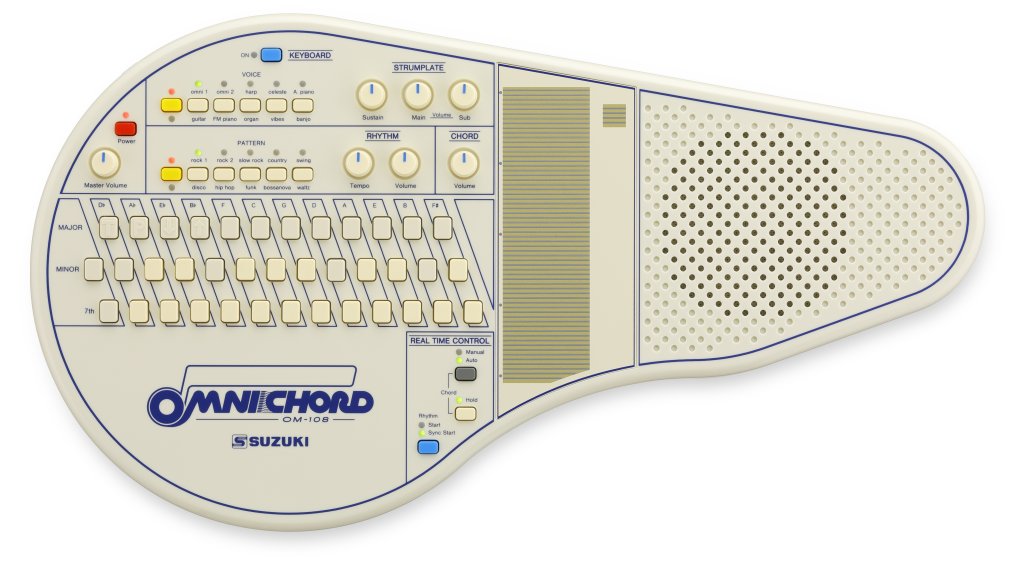
The basic idea is consistent, but the feel changes from model to model. Early OM-27 instruments can use a capacitive touchplate and a special conductive plectrum. Later models use membrane SonicStrings. The current OM-108 uses a new sensitive strumplate area under the upper panel, with the tactile surface presented as a sticker.
Because these instruments span several decades, always check the correct manual for your model before cleaning, powering or adjusting anything.
Find your owner's guide
Download the correct Suzuki manual before exploring deeper functions.
WordsGlossary
Quick explanations of strumplate, SonicStrings, Instant Off and more.
ModelsOmnipedia
Compare the different Omnichord and Qchord models.
CareSafe checks
Useful if a vintage instrument behaves strangely or will not power on.
Try a song
Once you can move between two or three chords, pick a simple song where the chord names are written above the words. You do not need to copy the melody at first. Hold the correct chord, strum through that part of the song, then move to the next chord when the chord name changes.
Singers often find this especially natural: the Omnichord supplies a warm backing bed while the voice carries the melody.
Next step
Finger-picking notes across the strumplate.
The strumplate is divided into octave areas, marked by the printed dots along the side. Once you know where those octaves sit, you can pick individual notes between your strums instead of always sweeping the whole plate.
If you hold a C chord, the strumplate gives you C notes across five octaves. Change to F, and those same octave positions become F notes. This opens the door to simple accompaniment melodies, little answering phrases and gentle arpeggios while the chord is still doing the musical work underneath.
Now showing: OM-108 single-note picking across the strumplate octaves.
Try an Omnichord online
If you do not yet own an Omnichord, the fastest way to understand the idea is to try one of the Omnichord Heaven online instruments. OH-84 is designed for desktop, laptop and larger tablet screens, while OH-27 is the official Omnichord Heaven Android app for mobile play.
OH-84 Lite
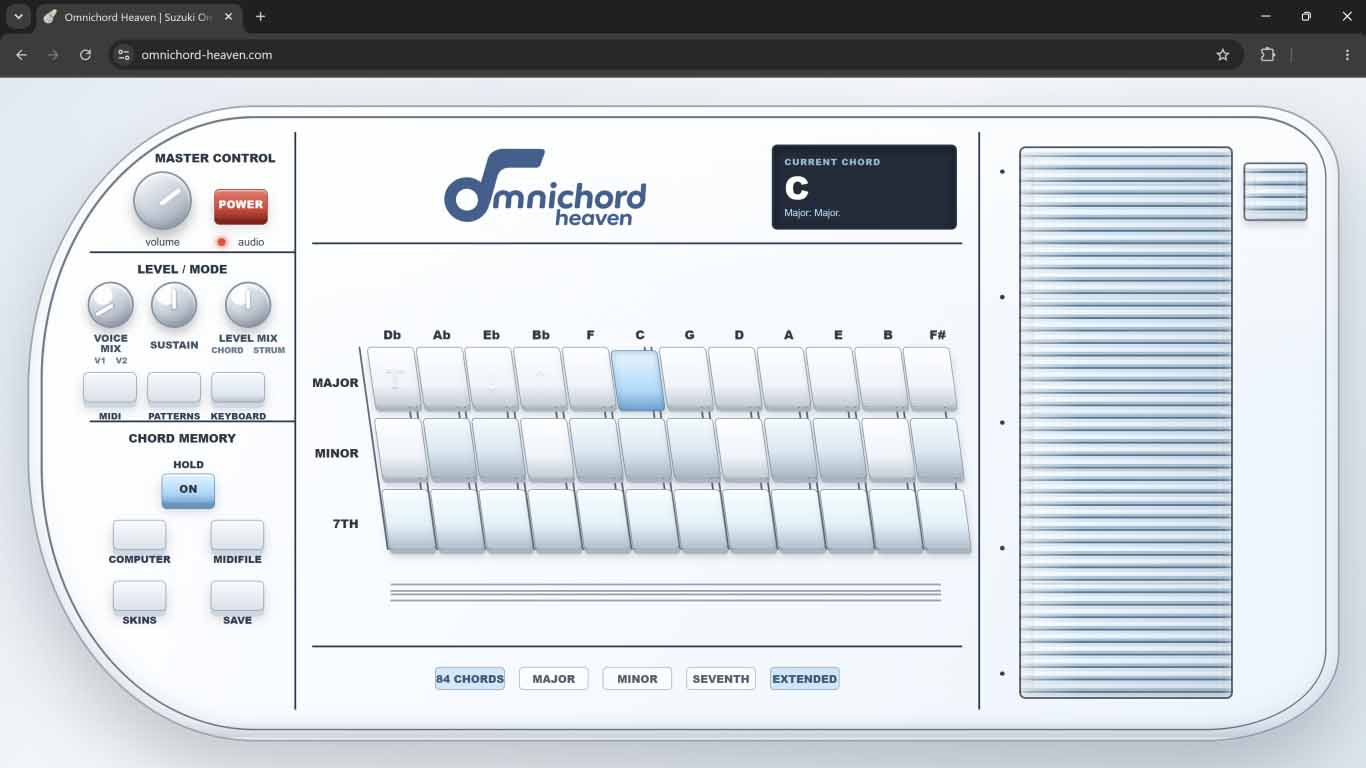
Play an OM-84 style chord-and-strum instrument in your browser.
Suzuki OM-108
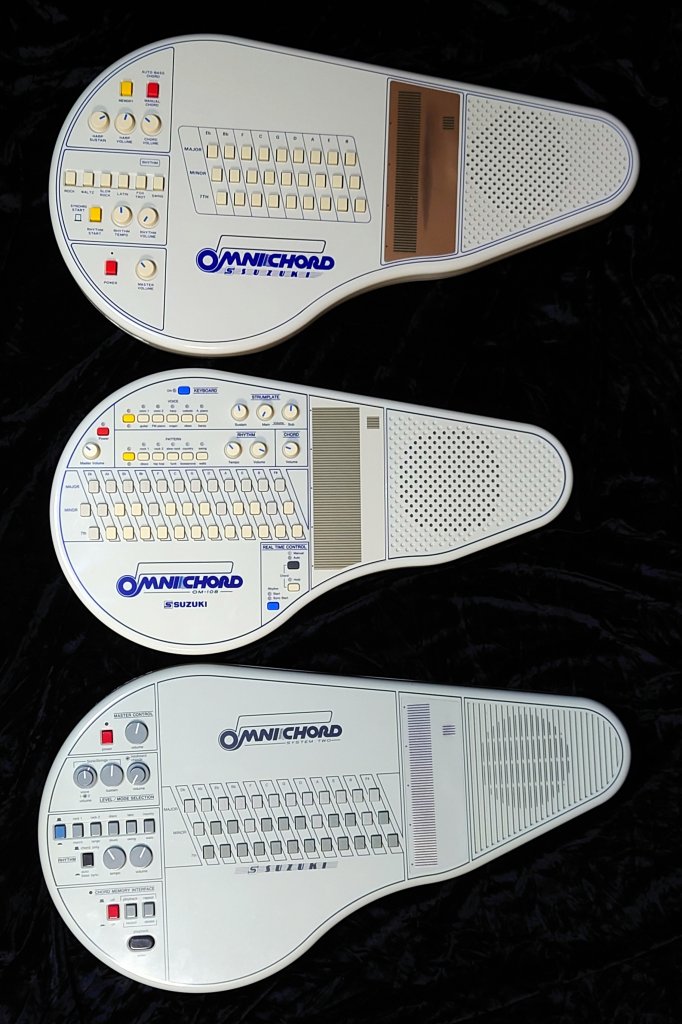
The current Suzuki Omnichord combines familiar playability with modern voices and MIDI.
Beginner safety notes
Vintage Omnichords are valuable and some parts are no longer available. Use the correct power supply, avoid random adapters, do not spray cleaners into the instrument, and never use guitar picks on membrane SonicStrings. If a model is not responding normally, stop and check the repair symptom guide before trying to force it back into life.
More videos will be added here.
This first playing example is now part of the guide. More short tutorial videos can be added section by section without changing the page address.