Make Your Own Kind of Music
Our first impressions of the Suzuki Omnichord OM-108
Here at Omnichord Heaven we were very excited to meet Suzuki's brand-new Omnichord. This is our in-depth first review of the instrument.
The OM-108 was three years in the making, and every aspect reflects requests and wishes from the Omnichord community. Suzuki's hope was that it would carry the instrument's beautiful sound and unique 40-year legacy into a new generation.
The shape
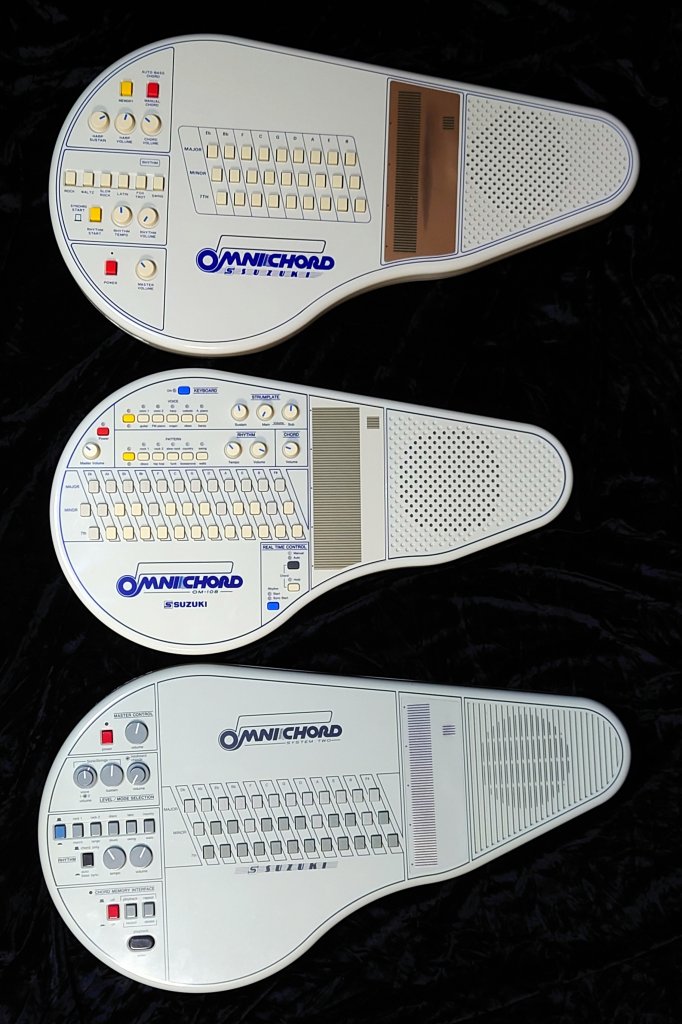
The OM-27 and OM-84 have proved to be two of the most popular Omnichords. At the time of this preview the OM-84 was in especially great demand, and we had seen examples sell for well over £700. Suzuki retained that much-loved early shape for the OM-108, while slightly reducing its length and width so it is easier to carry and perform with. The height remains the same.
AA batteries help with the weight too. With batteries installed, the OM-108 weighs just over 1.4 kg, compared with a little over 1.8 kg for an OM-27.
The colour was carefully matched to an original OM-27 ivory. In fact, our own OM-27 travelled around the world to help ensure that the new instrument would look and feel familiar.
The layout
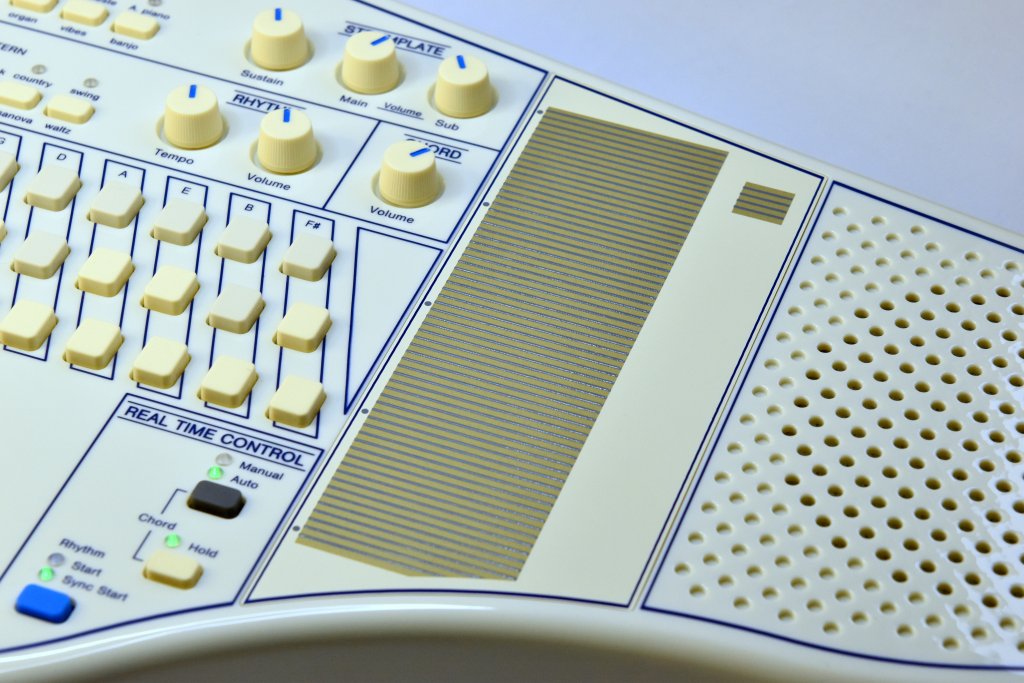
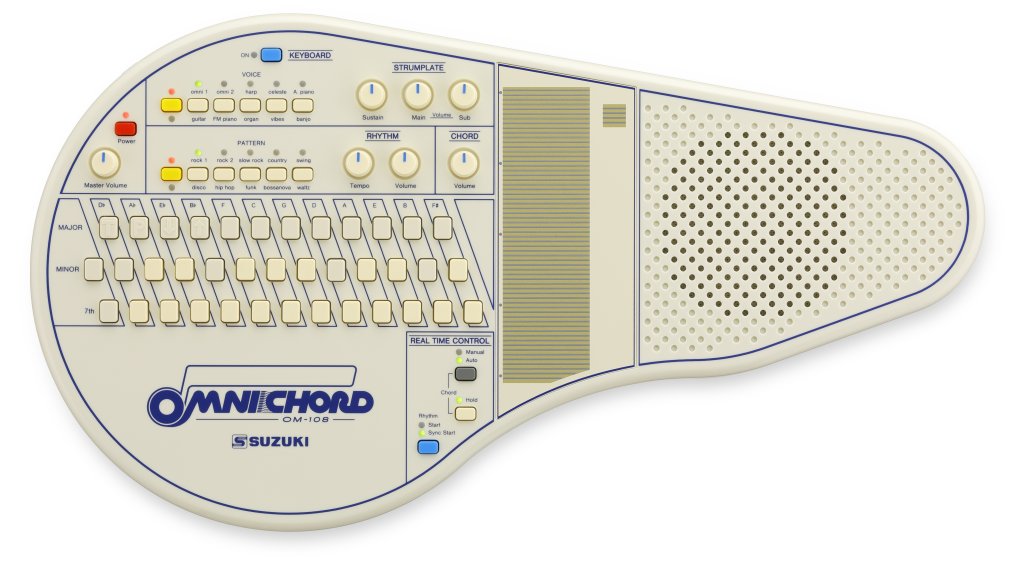
It is oh, so familiar. Straight away we felt at home with the OM-108. Everything from the beautifully printed logo to the OM-27 button colours makes it feel like a real Suzuki Omnichord.
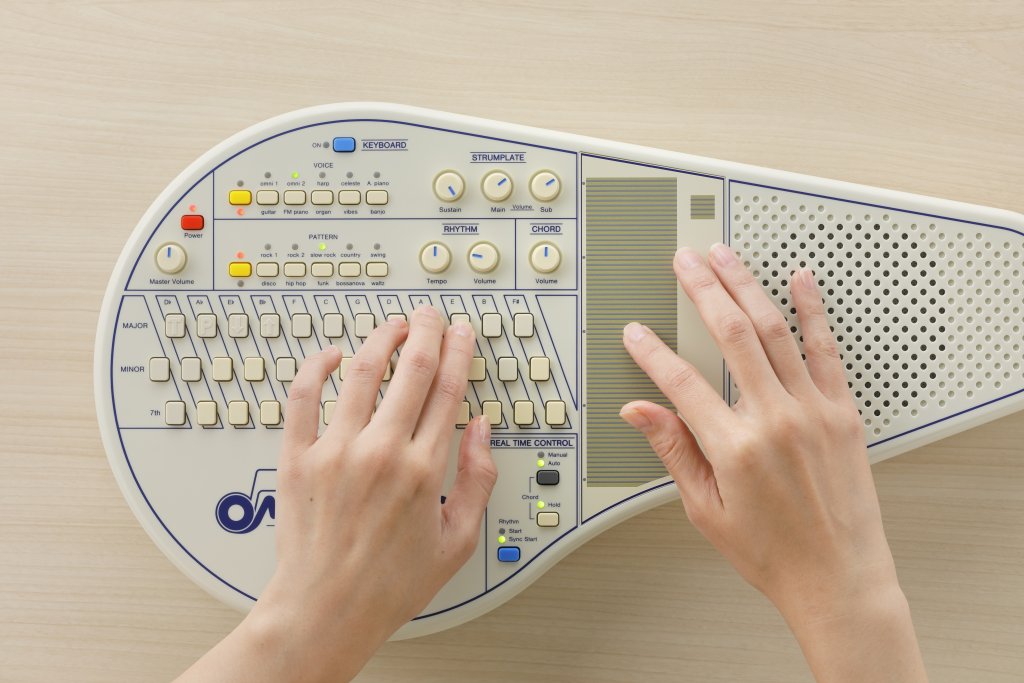
The strumplate—which has a perfect touch—is wider than the original versions, so players used to the ergonomic plate found from the OM-100 through to the QC-1 should not be disappointed. Its extra width follows the natural arc of your hand, and it remains sensitive right to each edge, meaning no missed notes. The instant-off touch plate is sensibly positioned so it is difficult to hit accidentally.
Controls and connections
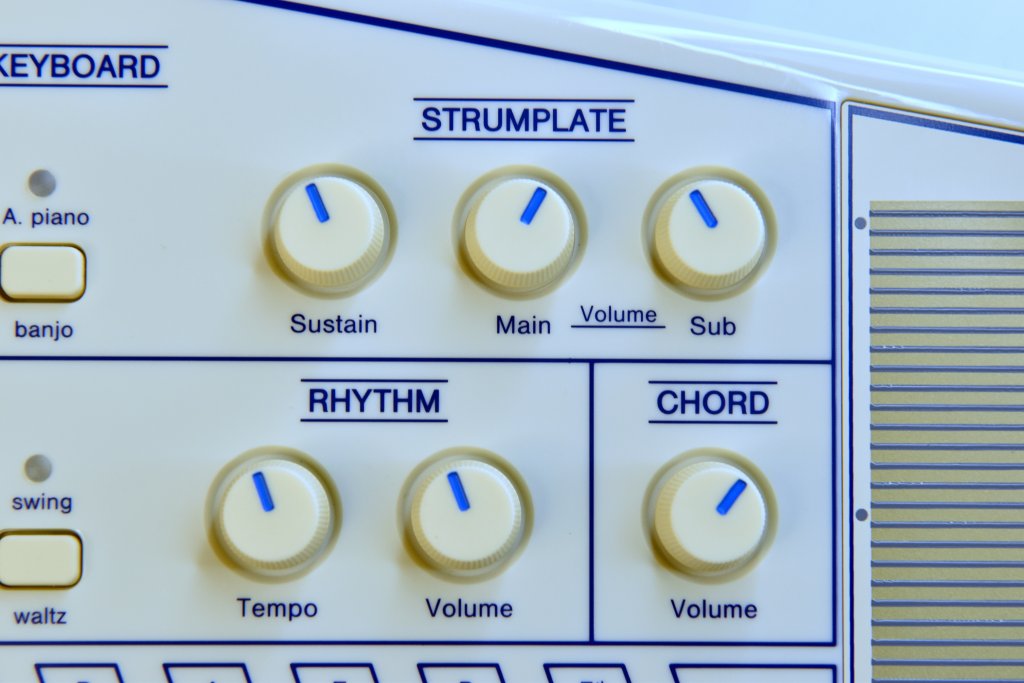
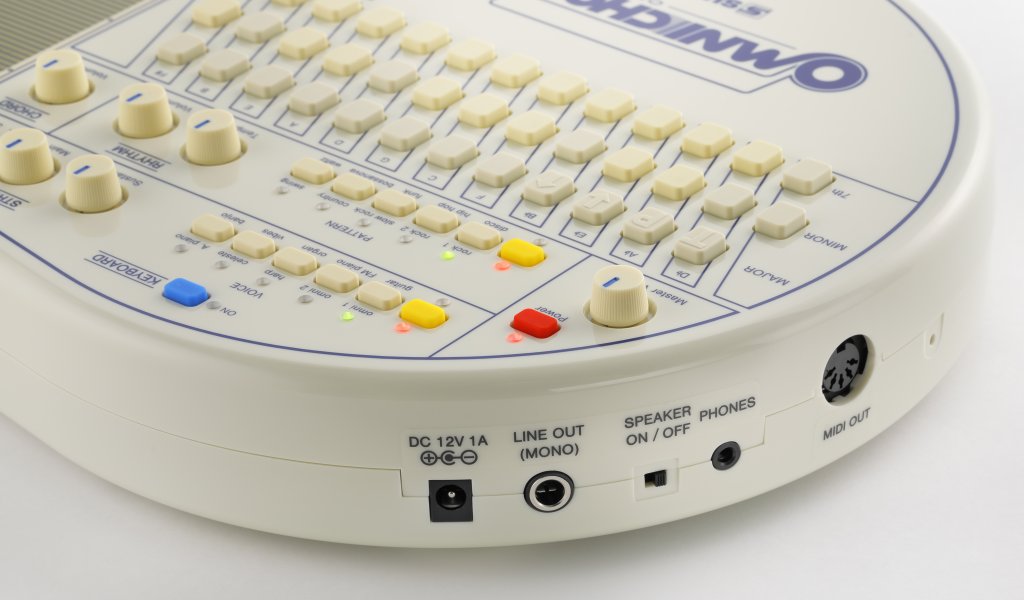
The buttons use lovely soft-touch rubber, as Omnichords have done since the OM-36 and OM-84. Better still, the rotary controls are back. They are not as wide as the OM-84 controls, but we had no difficulty making changes on the fly, and their position near the top of the strumplate is easy to reach.
Two additional chord buttons expand the palette from 84 to 108 chords—hence the name. The new chord types are Sus4 and Add9. Suspended chords had been requested by players, including me, for many years, so this is a genuinely exciting addition.
The speaker grille recalls the OM-27, while the speaker itself delivers some serious bass response. At the rear-left edge, the sockets sit where cables will not get in the way during a performance. The monitor switch is especially useful when sending the instrument to an external speaker while keeping the internal speaker active. Apart from the first batch of OM-27s, earlier Omnichords normally go silent when a jack is inserted, so this is a thoughtful addition. We also found the headphone quality excellent.
The MIDI Out port is a treat for anyone who wants to use the Omnichord as a controller. It was one reason for the original release delay: Suzuki put a great deal of work into future-proofing the OM-108.
Underneath are the familiar raised rubber feet and a compartment for eight AA batteries, including NiMH rechargeables. Our sample also had a USB port intended for firmware updates; at the time we did not know whether it would appear on the production model. Even the commission plate received close attention so its colour, type and proportions would feel familiar to long-time owners.
The sound
Switch on the OM-108 and a small LED display appears while the instrument readies itself. Press a C chord and Rock 1 begins—and it immediately recalls an OM-84, updated with a rich, unmistakably Omnichord-like bass line. We could hear Stevie Wonder's “I Just Called to Say I Love You” in our heads.
The vamping chords use voicing reminiscent of the OM-27 and OM-84, and the drums are gloriously 1980s. The patterns are longer, with a small change at the end of the fourth bar, and the accompaniment follows chord changes cleanly even when they happen part-way through a bar.
Then there is the strumplate. It has the lightly raised texture of older models and responds beautifully—even through white gloves. Best of all, the power-on voice sounds just like our OM-84. There is a reason: the Omni 1 and Omni 2 voicing is analogue. As on the OM-84, the dual voice is adjustable, so raising the Sub control adds vibrato beneath the straight Main voice.
Rhythm patterns
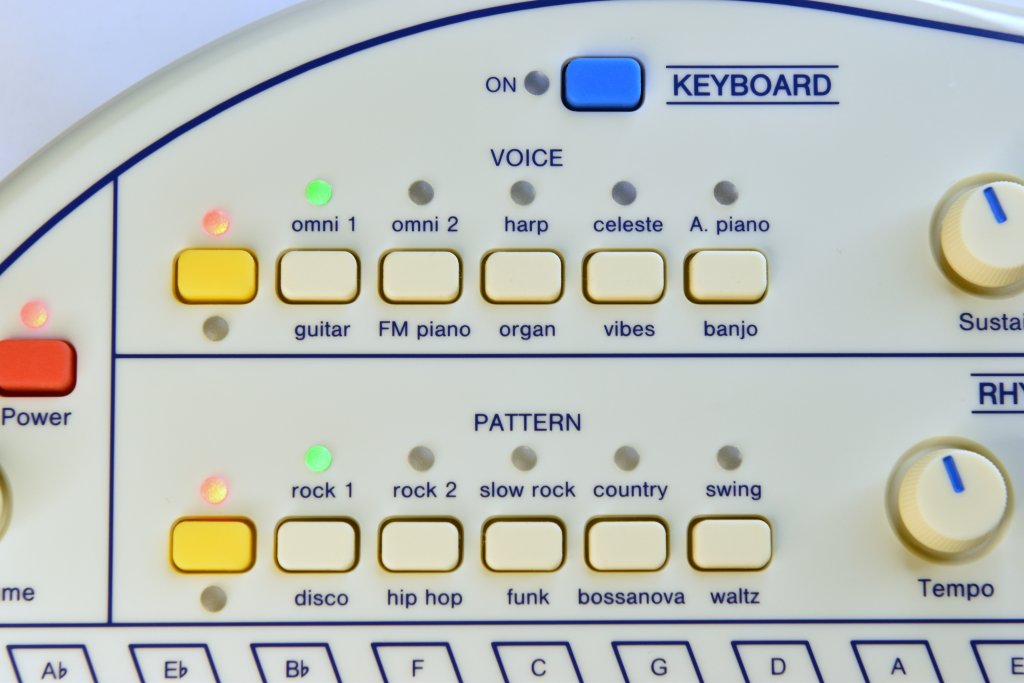
The selection is sensible. There are ten patterns, but they represent millions of song possibilities and are generic enough to let you, as Suzuki says, “Make Your Own Kind of Music”.
- Rock 1 — a traditional rock rhythm.
- Rock 2 — a Bo Diddley-feeling pattern unlike anything heard on an earlier Omnichord. Think George Michael's “Faith” or Amy Winehouse's “Valerie”.
- Slow Rock — a gorgeous 12/8 pattern with lovely cymbals.
- Country — works at almost any tempo and recalls later OM-series country patterns.
- Swing — a traditional pattern similar to previous models.
- Disco — an absolute four-on-the-floor powerhouse with a hopping octave bass line. We could not resist the “Blue Monday” chord sequence.
- Hip Hop — a classic 808-style trap beat with a thick bass line.
- Funk — getting jiggy with it.
- Bossa Nova — a beautiful Latin pattern with particularly nice analogue-sounding percussion.
- Waltz — unmistakably like the OM-27 pattern, with a slight bass variation at the end of bar four.
The rhythm unit offers separate levels for drums and accompaniment, with bass and chords adjusted together, plus a useful tempo range. Sync Start triggers the rhythm with the first chord. Hold keeps it playing after the chord button is released; switch Hold off and the rhythm stops with your finger. Manual changes the accompaniment between vamping and the much-loved Omnichord drone—ideal for playing without drums. With Hold off, chord buttons can also be played staccato.
Voicing
The analogue Omnichord voices would have been enough to excite us, but Suzuki added a generous selection of sounds. Omni 1 is pure OM-84. Omni 2 keeps the OM-84 Main voice and adds a rich synth-orchestral string tone on Sub. The result is enormous, and because the strumplate voice can be held without decaying it opens up many more ways to create your own material.
- Harp — genuinely harp-like, with the sensitivity of the strumplate especially noticeable. We plucked out “Canon in D” and were stunned into silence; a little Sub volume layers lovely strings beneath it.
- Celeste — like playing a music box, again with strings on the Sub voice.
- Acoustic Piano — no plinky-plonky sound here. The delay is beautifully judged, and piano works surprisingly well on a strumplate.
- Guitar — a steel-string sound with rich lows, sparkling highs and carefully shaped delay and decay. Sub adds orchestral strings.
- FM Piano — a very 1980s, DX7-like electric piano with an organ-like synth pad on Sub. We could already imagine that Sub voice appearing in songs.
- Organ — Suzuki also makes Hammond organs, and it shows: this voice includes a tremolo or Leslie-style effect, with strings beneath.
- Vibes — Suzuki's experience making mallet instruments comes through clearly. Strings are available on Sub.
- Banjo — wonderfully authentic when picked across the strumplate, again with a string layer on Sub. We could not wait to hear what other players would do with it.
A hidden OM-84—and a drum pad
The OM-108 contains an Easter egg: a hidden OM-84. Restart it with a special button combination and the drums and accompaniment change to sound just like the older instrument.
There is also a keyboard mode and a Drum Pad mode that really has to be tried. We used it to play drum introductions, including the bass drum at the beginning of “Blue Monday”. When the rhythm unit is running, the strumplate triggers drum voices in time with the tempo, making it easy to drop a drum break into the middle of a song.
That was all for our first look. MIDI deserved a closer review of its own.